
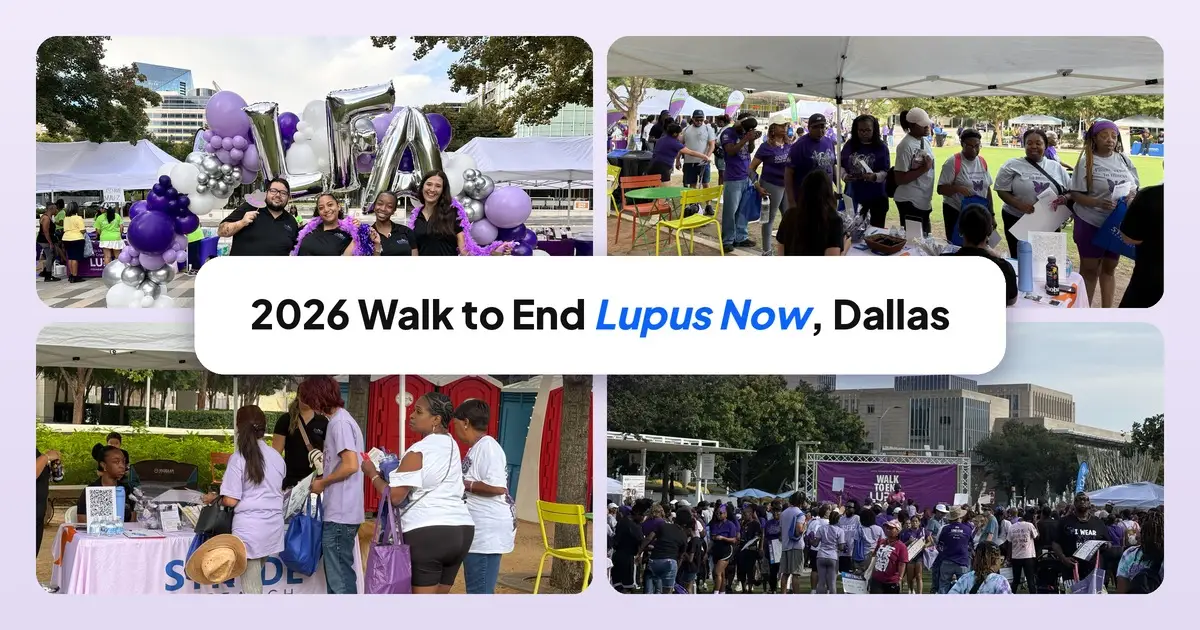
On September 26th, our patient recruitment team spent the morning at the 2026 Walk to End Lupus Now, Dallas, hosted by the Lupus Foundation of America at Klyde Warren Park. We came to listen and hand out a few survival kits.
We left with a clearer picture of who shows up for lupus, why they walk, and what people want to know about clinical research. Here is what stood out.
People travel far to be there
More people than we expected came from outside Dallas. Our team talked with attendees who had traveled in from Houston, San Antonio, and other Texas cities to be there. For a disease that can feel isolating, people were willing to drive hours to spend a morning in a crowd of others who understand it.
That tells us the Walk to End Lupus reaches well beyond the local community. It also tells us that when we think about where lupus patients and families are, the answer is wider than any one metro area.
Many attendees were walking for someone else
This was one of the clearest takeaways. A large share of the people we met were walking for someone else: a mother, a best friend, a cousin. They did not have lupus themselves. They came because someone they love does, and they wanted to do something about it.
Many of them asked what else they could do to help. Caregivers and family members are part of the lupus community in a real way, and they are often the ones who carry information back to the person living with the disease. Several people took our materials to pass along to someone they knew.
Our team learned about lupus from the people living with it
Some of our team members had not realized how heavily lupus affects women. In conversations at the table, they heard about women who were diagnosed as young as 11 years old. Hearing it from people directly, rather than reading it in a fact sheet, landed differently.
“I had no idea lupus was heavily in women, and some women were diagnosed as early as 11 yrs old!! It was great to see everyone there with such upbeat reactions and so supportive of anyone strugging with the disease.”
For a recruitment team, that matters. Patients can live with symptoms for a long time before they have a name for them, and a diagnosis at a young age means decades of managing a chronic condition. Plain, patient-centred conversation about what research involves has to account for that history.
The mood was joyful as well as serious
There was dancing, laughter, and a lot of smiles. One attendee was thrilled to get one of our branded fans and used it to dance with. People were upbeat with each other, and they were generous toward anyone who was struggling with the disease.
We came in expecting a serious event, and it was serious. It was also joyful. Those two things were true at the same time, and the community seemed to hold both without effort.
Curiosity about clinical research is already there
Many attendees showed real interest in how clinical studies work and how they might help move treatment options forward for people with lupus. They asked questions, took information, and said they would share it with people they know.
We want to be careful here. A conversation at a walk is not a recruitment pitch, and we did not treat it as one. What it showed us is that curiosity about research is already there. People often just need someone to explain it plainly and without pressure.
What this means for how we work
Three things we are taking back:
- Meet people where they already are: Understanding the lupus community outside the clinic matters as much as the work inside it.
- Include the people around the patient: Family members and friends are listening, and they are often the first to hear about a study.
- Lead with plain answers: People want to know what research actually involves. Short, honest explanations earn more trust than a polished pitch.
Thank you to the Lupus Foundation of America for hosting, to everyone who stopped by our table, and to the team members who spent the morning there: Moraima, Laila, Noah, and Alma.
If you would like to learn more about Stryde’s rheumatology research, you can reach our patient team at patients@stryderesearch.com.